



Cutle asks you to do something that sounds almost effortless: cut a shape exactly in half. There are no complicated controls, long tutorials, or confusing objectives.
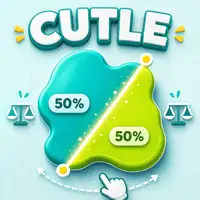
Here's a quick look at the game:
A Small Puzzle About Visual Judgment
The difficulty of Cutle comes from the difference between length and area. Players often try to place the cutting line halfway between the left and right edges of a shape. That works for a symmetrical rectangle, but it quickly fails when the figure has curves, narrow sections, or an uneven outline.
A large-looking section may contain very little filled space. A small rounded section may contain more area than expected. The game rewards players who stop thinking about distance and start thinking about visual weight.
Chasing the Perfect Cut
After making a cut, Cutle shows the ratio between the two resulting pieces. A nearly balanced attempt might produce 49:51 or 49.9:50.1. These results look excellent, but perfection requires an even more precise split.
This creates a satisfying replay loop. Move the starting point slightly. Change the angle by a tiny amount. Compare the new result with the previous one. Each attempt teaches you something about the shape.
Symmetrical figures are usually the easiest. Find their natural axis and follow it carefully. With irregular figures, imagine balancing the two pieces on a scale. The goal is not to make them look identical, but to give them the same total area.
Simple Controls, Real Precision
Cutle works well because every attempt is fast. A round can last only a few seconds, yet improving a score can take many carefully adjusted cuts.
The trophy system also gives players several achievable targets. A Bronze or Silver result shows that the basic estimate was close, while Gold and Perfect results demand much greater accuracy.
Whether you play one shape or work through the full collection, Cutle offers the same question every time: can you trust your eyes enough to find the exact middle?